

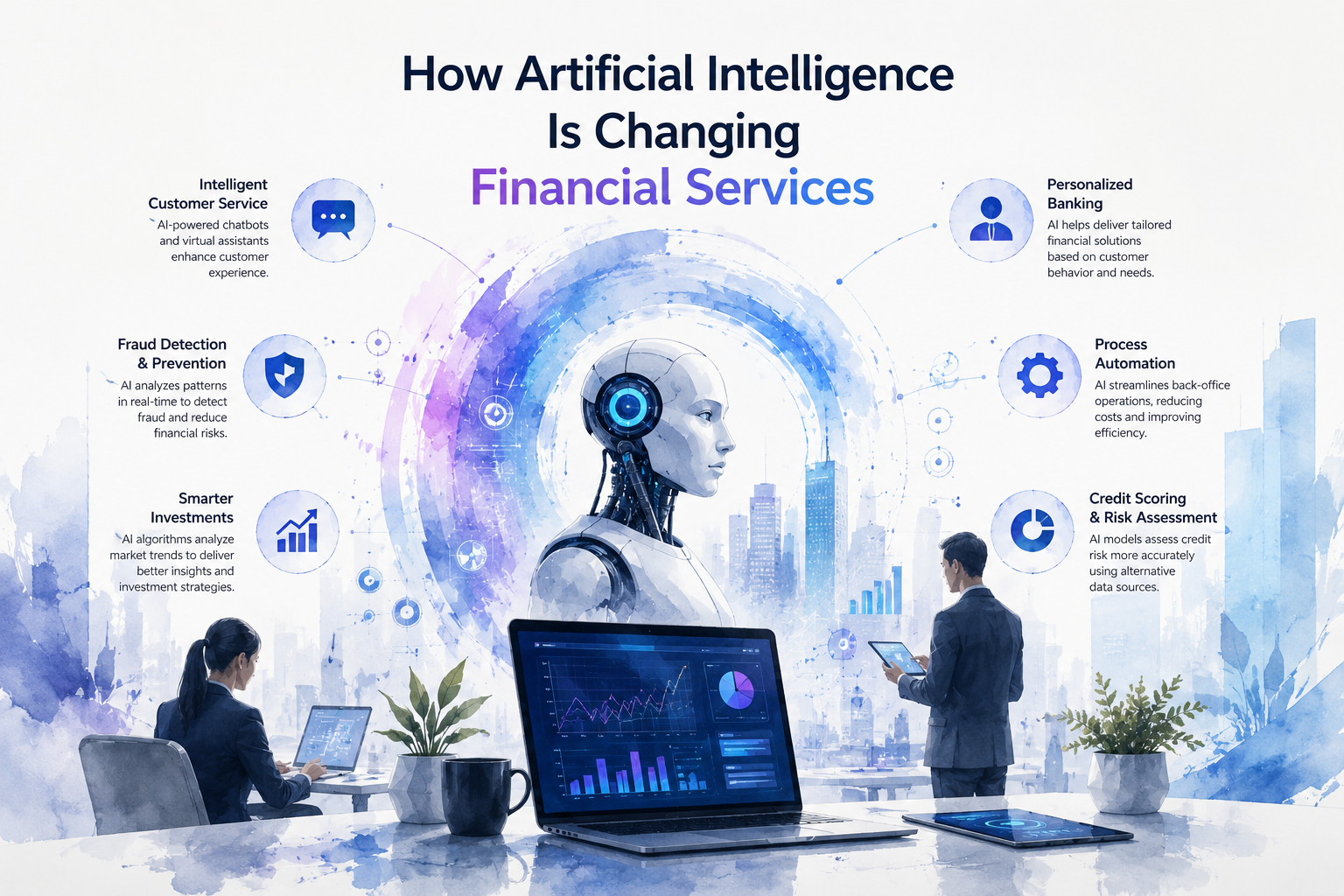
Discover how AI in Finance is transforming banking, payments, fraud detection, investment management, and customer service across the financial industry.
How Artificial Intelligence Is Changing Financial Services
The financial services industry has entered a new era of digital transformation, driven by rapid advances in artificial intelligence. From automating routine processes to improving fraud detection and delivering personalised financial advice, AI in Finance is reshaping how banks, insurance companies, investment firms, and financial technology providers operate.
Artificial intelligence enables financial institutions to process vast amounts of information in real time, identify patterns, and make faster, more informed decisions. As customer expectations continue to evolve, AI is becoming an essential tool for delivering efficient, secure, and innovative financial services.
What Is AI in Finance?
AI in Finance refers to the use of artificial intelligence technologies such as machine learning, natural language processing, predictive analytics, and automation within financial services.
Financial organisations use AI to:
- Analyse financial data
- Detect fraudulent transactions
- Automate customer support
- Improve lending decisions
- Personalise financial products
- Manage investment portfolios
These technologies help improve accuracy while reducing operational costs and increasing efficiency.
Why AI in Finance Is Important
Financial institutions manage enormous volumes of data every day. Analysing this information manually is time-consuming and prone to human error.
AI in Finance helps organisations:
- Improve decision-making
- Reduce fraud
- Enhance customer experiences
- Increase operational efficiency
- Strengthen risk management
- Support regulatory compliance
As financial systems become more digital, artificial intelligence continues to play a larger role in maintaining secure and efficient operations.
1. Smarter Fraud Detection
Fraud prevention is one of the most valuable applications of AI in financial services.
Artificial intelligence can:
- Monitor transactions in real time
- Detect unusual spending patterns
- Identify suspicious account activity
- Reduce false fraud alerts
- Improve identity verification
Machine learning systems continuously improve by learning from new transaction data, making fraud detection more accurate over time.
2. Personalised Customer Experiences
Modern customers expect financial services that are tailored to their individual needs.
AI helps financial institutions provide:
- Personalised product recommendations
- Custom savings suggestions
- Spending analysis
- Financial planning insights
- Individualised investment guidance
Personalisation improves customer satisfaction while strengthening long-term relationships.
3. AI-Powered Customer Support
Many banks and financial service providers now use AI-powered virtual assistants to support customers around the clock.
These systems assist with:
- Account enquiries
- Balance information
- Payment support
- Loan applications
- Card management
- Frequently asked questions
AI chatbots improve response times while allowing customer service teams to focus on more complex enquiries.
4. Better Credit Risk Assessment
Traditional lending decisions often rely heavily on historical financial information.
AI enhances credit assessments by analysing:
- Transaction history
- Spending behaviour
- Income patterns
- Repayment history
- Financial stability indicators
More comprehensive analysis helps lenders make better-informed decisions while reducing credit risk.
5. Investment Management and Robo-Advisors
Artificial intelligence is transforming investment management through automated advisory platforms.
AI-powered investment tools help investors:
- Build diversified portfolios
- Monitor investment performance
- Assess market conditions
- Optimise asset allocation
- Manage financial goals
These solutions provide efficient investment support while making financial planning more accessible.
6. Predictive Financial Analytics
Predictive analytics allows financial institutions to anticipate future trends based on historical and real-time data.
Businesses use AI to forecast:
- Customer demand
- Cash flow
- Market movements
- Loan defaults
- Investment performance
- Business risks
Accurate forecasting supports better strategic planning and financial management.
7. Regulatory Compliance
Financial institutions must comply with numerous regulations designed to protect consumers and maintain market stability.
AI helps automate compliance by:
- Monitoring transactions
- Identifying unusual activities
- Generating compliance reports
- Supporting anti-money laundering processes
- Detecting regulatory risks
Automation improves accuracy while reducing administrative workloads.
8. Process Automation
Many financial operations involve repetitive administrative tasks.
AI automates activities such as:
- Invoice processing
- Document verification
- Claims processing
- Payment reconciliation
- Data entry
- Account management
Automation reduces processing times while improving operational efficiency.
9. Cybersecurity and Risk Management
As financial services become increasingly digital, cybersecurity remains a major priority.
AI strengthens security through:
- Behavioural analytics
- Threat detection
- Identity verification
- Fraud monitoring
- Risk assessment
- Continuous security monitoring
These technologies help financial organisations respond quickly to emerging cyber threats.
10. Improving Business Decision-Making
Financial institutions increasingly rely on AI-generated insights when making strategic decisions.
Artificial intelligence supports leaders by providing:
- Market analysis
- Customer behaviour insights
- Operational performance reports
- Investment forecasts
- Risk evaluations
- Revenue projections
Data-driven decision-making improves both efficiency and long-term planning.
Challenges of AI in Finance
Despite its many advantages, AI adoption presents several challenges.
Businesses must consider:
- Data privacy
- Regulatory compliance
- Cybersecurity risks
- Algorithm transparency
- Employee training
- Integration with legacy systems
Responsible AI implementation requires strong governance, ongoing monitoring, and compliance with financial regulations.
The Future of AI in Finance
Artificial intelligence is expected to become even more integrated into financial services over the coming years.
Future developments may include:
- More advanced fraud detection systems
- Smarter digital banking platforms
- Highly personalised financial products
- Real-time financial forecasting
- Enhanced regulatory technology
- Greater automation of financial operations
As AI capabilities continue to evolve, financial institutions will have more opportunities to improve customer experiences and operational performance.
Best Practices for Financial Organisations
Businesses adopting AI should focus on:
- Protecting customer data
- Investing in cybersecurity
- Training employees
- Maintaining regulatory compliance
- Monitoring AI performance
- Ensuring transparency in automated decisions
A responsible approach allows organisations to maximise the benefits of AI while maintaining customer trust.
Conclusion
AI in Finance is transforming financial services by improving fraud detection, automating operations, enhancing customer experiences, and supporting smarter business decisions. From digital banking and investment management to risk assessment and regulatory compliance, artificial intelligence is helping financial institutions operate more efficiently in an increasingly digital world.
As technology continues to advance, organisations that embrace AI responsibly will be better positioned to deliver innovative financial services, strengthen customer relationships, and remain competitive in the future of global finance.
